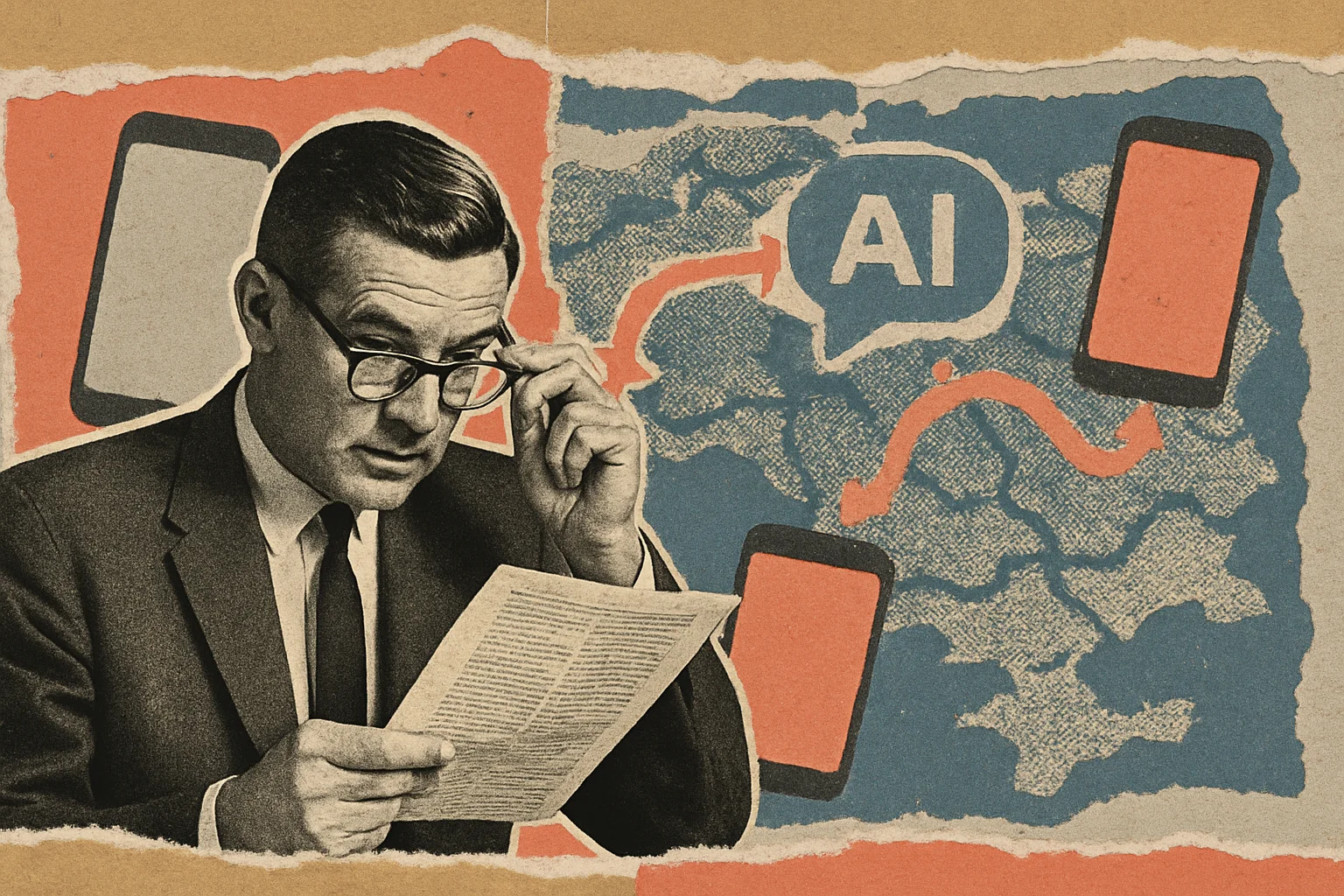
Something stopped working.
Not overnight. Not because of a competitor launch or a regulation you missed. The campaigns that delivered last year deliver less now. The pipeline that filled itself needs more effort to produce the same output. You look at the numbers, and they don't lie, but they don't explain either. Nothing changed on your end. That is the problem.
Why Are 71% of Businesses Invisible to AI?
Because most websites were built for Google's index, not for AI training data. A SAVI analysis (a website AI-visibility benchmark) of 350,000 sites across 28 industries found that 71% score so low on AI visibility they are effectively invisible. Only 0.12% of websites are optimized for AI discovery, less than 1 in 800.
The AI revolution is the loudest disruption in a generation. We see it on every headline, in every boardroom deck, in every investor call. We know it replaces jobs, reshapes industries, and rewrites the rules of productivity. None of that feels personal. It feels like something happening to other companies, other industries, other people.
But here is what we are not connecting: your buyers are using AI the same way you are. They open ChatGPT, Claude, or Perplexity to research solutions, compare vendors, and make shortlists. They ask "what is the best marketing automation platform for mid-market B2B?" and get an answer. Not a list of 10 blue links. An answer. One that either includes you or does not.
This has zero correlation with brand size. Vanguard, one of the largest asset managers in the world, scores 16 out of 100 on AI visibility. Fidelity scores 15. Meanwhile, smaller expert-led sites with clear, structured content score 80 and above. The moat you spent 20 years building, your brand recognition, your Google rankings, your domain authority, none of it transfers automatically to the AI layer.
The proof shows up first in B2B (business-to-business) categories where the stakes are highest. AthenaHealth, a $15 billion B2B healthcare software company, discovered through Evertune AI that it wasn't showing up in AI searches about its own category. The New York Times covered the case as part of its reporting on GEO (Generative Engine Optimization). Brian Stempeck, Evertune's CEO, frames why high-complexity B2B feels the shift first: "high complexity, high intent, high price, high importance categories" are exactly the ones where buyers turn to AI for help, and exactly the ones where being unlisted means losing the deal before you knew it existed.
A Gartner survey from February 2026 puts the blind spot in sharp relief: 65% of CMOs (Chief Marketing Officers) say they expect AI to disrupt their role. Only 32% say they need significant new skills to deal with it. Two-thirds see the wave. One-third thinks they need to learn to swim. That gap is not ignorance. It is the specific cognitive failure of experienced leaders who have survived previous technology shifts and assume this one works the same way. It does not.
The disruption is quiet because you are inside it. You use AI for discovery every day and do not register that your buyers do the same. You Google less and prompt more, and so do they. But when you look at your own marketing performance, you check the old dashboards: traffic, click-through rates, keyword rankings. Those dashboards are going blind. Industry voices now project that 80 to 90% of Google searches in the next year or two may end without a click, the AI overview answers in place. The signals that underpinned digital marketing for 20 years are declining, and no new measurement has taken their place.
Is Your Robots.txt Blocking AI Crawlers?
It might be. Many B2B sites discover, after the fact, that their robots.txt file blocks GPTBot (OpenAI's crawler), ClaudeBot (Anthropic's crawler), and Google-Extended (Google's AI crawler) by default. IT or legal often makes the call without marketing in the loop. Mondelez found this on the Oreo brand site.
Before you ask whether AI knows you, ask whether AI can read you. The result of a blocked robots.txt is straightforward: the brand opted out before the visibility battle started. Check your robots.txt today. If the AI crawlers are blocked, you have a five-minute fix that recovers months of compounding loss.
What Hasn't Changed in B2B Buying?
The way buyers decide. Trust, expertise, and the quality of what you put in front of them still wins the deal. What changed is discovery, the layer before the decision, and AI now controls who shows up there.
Not everything is broken. The disruption is not in the handshake. It is in the hallway before the meeting. If AI does not surface your name during discovery, you never get to the room where the decision happens.
That is the cruelest part of a quiet disruption. You do not lose the deal. You never knew the deal existed.
What This Means
The companies that will win the AI layer aren't the ones who understand the technology best. They are the ones who recognize the shift in buyer behavior first and rebuild their content for an audience that no longer behaves like a Google user.
I have watched multiple technology waves hit marketing over 20 years. SEO rewrote discovery in the 2000s. Social rewrote distribution in the 2010s. Each time, the businesses that moved first did not move because they understood the technology. They moved because they recognized the shift in buyer behavior before their competitors did.
Marketing to a human gets you 3.2 seconds of attention if you are lucky. Marketing to AI is the opposite: AI wants depth, detail, every signal it can match against a buyer's question. As Stempeck puts it, you are talking to a "super influencer who wants to know as much as possible about your brand and category." The companies that will win in this layer are the ones that stop distilling their story to a tagline and start publishing the depth AI needs to confidently recommend them.
This is that moment. The technology is loud. The shift in your buyer's behavior is silent. And the businesses doing more of what used to work, spending more, publishing more, optimizing more for a system that is being bypassed, are the ones who will wake up 6 months from now wondering what happened.
The disruption is not coming. It arrived. The only question is whether you noticed.