If you run a small B2B or professional services firm and you have quietly decided that LinkedIn is not for you, I understand. The platform rewards a certain kind of performance that most competent operators find embarrassing. The good news: founder-led LinkedIn in 2026 requires less posting than you think, and almost none of the performance.
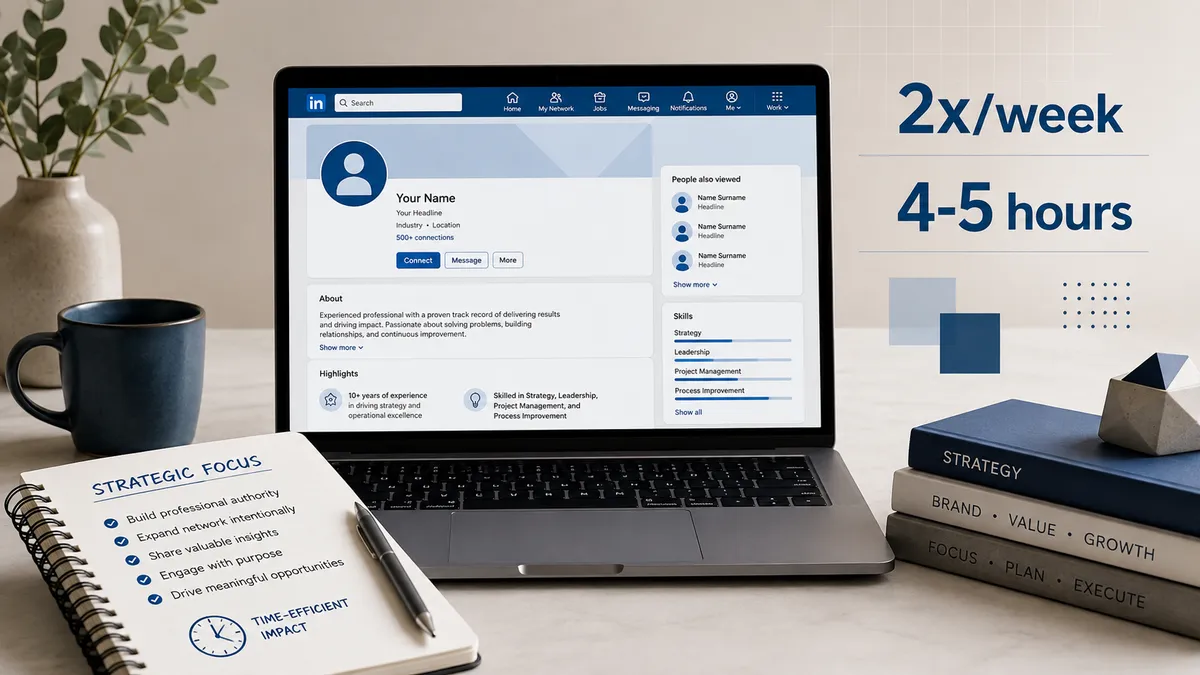
Here is the position, stated up front. Post twice a week from your personal profile, not your company page. Make one of those posts a document. Budget 4 to 5 hours a week for the whole operation, depending on how much daily engagement you can protect. That is the entire strategy, and the data behind each piece of it is stronger than most of what passes for LinkedIn advice.
Should you post from your company page or your personal profile?
Post from your personal profile. Personal profiles generate five to eight times the engagement of company pages, and for a small firm the page has no independent identity to trade on anyway.
Most owners default to the company page because it feels professional and it keeps the business separate from the person. That instinct is costing you most of your reach.
Digital Applied's analysis of the two channels puts the gap at 5–8x: personal profiles generate five to eight times the engagement of company pages. The mechanism is not mysterious. LinkedIn's algorithm distributes personal content through social graphs and interest signals, while company pages mostly reach people who already followed them. One channel compounds. The other broadcasts to a list.
Workflows.io's founder-led marketing playbook states it more bluntly: B2B buyers no longer follow company pages, they follow people.
That matters more for you than for a large enterprise. If you are a fractional CFO, a boutique agency owner, or a three-person consultancy, your company page has no independent identity to trade on. It is a logo. Your prospects are not evaluating a brand, they are evaluating whether you specifically know what you are doing. Sprout Social's advocacy research points the same direction: buyers trust information shared by people over information published by brand accounts, and salespeople who post regularly are 45% more likely to exceed quota.
None of this means you should delete the company page. Digital Applied is careful about this: pages still do real work for paid ads, hiring, and basic credibility checks. A prospect who finds you compelling will look up your company, and an empty page is a bad signal. Keep it alive, keep it accurate, and stop expecting it to generate anything.
The practical move is a reallocation, not a rebuild. Whatever attention you were giving the company page goes to your profile instead. The page becomes a reference asset. You become the channel.
Which LinkedIn format wins in 2026: documents or video?
Documents. Native document posts — PDF carousels — out-engage video, images, and text across every 2026 dataset available, and almost nobody is making them.
The second decision is format, and this is where 2026 diverges sharply from what you were told two years ago.
Everyone spent 2024 and 2025 being told to make video. On LinkedIn specifically, that advice is now wrong. Socialinsider's 2026 LinkedIn Benchmarks Report, covered by Social Media Today, analyzed 1.3 million posts across 16,645 business pages between January 2024 and December 2025. Native document posts, meaning PDF carousels, drove higher average engagement than image posts, multi-image posts, or video. Social Media Today flagged how unusual that is: it reverses the pattern on other major platforms, where video dominates.
Dataslayer's independent read of the February 2026 algorithm lands in the same place with harder numbers. Documents post a 6.60% engagement rate, the highest of any format. Native video sits at 5.60%. Text-only posts sit at 2.00%. Carousels Generator's read of the 2026 algorithm reports a 7.00% carousel engagement rate against a platform-wide average of 5.20%, up 14% year over year while non-carousel reach fell by half.
Three sources, three methodologies, same conclusion. Socialinsider's 1.3 million-post sample and Dataslayer's algorithm analysis carry the weight here; Carousels Generator is a vendor blog and reads as directional support rather than independent proof. Even discounted, that is about as much agreement as you get in social media analytics.
Why documents? The ranking system explains it. LinkedIn replaced its legacy ranking stack with 360Brew, a unified AI ranking model, and 360Brew weights dwell time heavily over passive impressions. A document post asks the reader to swipe. Each swipe is time on the post. A text post is consumed in a single glance and scrolled past. Carousels Generator also reports that saves and sends now outrank likes as ranking signals, and a 9-slide breakdown of how to price a retainer is exactly the kind of thing people save.
One honest caveat, which the source itself raises. Social Media Today notes that document posts are rare in Socialinsider's dataset, and their scarcity may be inflating the measured lift. Read that as a feature rather than a warning. If documents perform well partly because almost nobody makes them, the strategic implication is to make them before that stops being true. Novelty premiums are real and they expire.
How often should a founder post on LinkedIn?
Twice a week. Two strong posts beat seven average ones, and every credible 2026 source lands in the 2–3 per week range — several report that posting more actively dilutes your reach.
The daily posting advice is the single biggest reason owners bounce off LinkedIn. It is also the least defensible.
Hyperclapper's contrarian piece on personal branding makes the incentive argument well: most LinkedIn advice is produced by people selling LinkedIn courses, and the advice that sells courses is the advice that makes the platform feel like a full-time job. Their conclusion, after working through the mechanics, is that daily posting only works if every post earns meaningful engagement, which is rare in practice.
Two strong posts a week beat seven average ones. Carousels Generator goes further and argues that posting more than 3x a week actively dilutes reach. It offers no mechanism, but the obvious reading is that you end up splitting your own audience's attention across your own content. Workflows.io recommends 2 posts a week plus one quarterly long-form piece. Digital Applied recommends 2–3 personal posts a week. Four sources, one range.
There is a timing constraint that makes low frequency more sensible, not less. The algorithmic promotion window has compressed to roughly the first 90 minutes after publishing, down from about 4 hours in 2024, according to Carousels Generator. Dataslayer reports that only 5% of posts that underperform in their first hour ever recover wider distribution. Posts are decided fast and permanently.
That changes the math. If a post's fate is sealed in 90 minutes, and you need to be present in those 90 minutes to answer comments and generate the early signal, then 7 posts a week means 7 blocks of reactive attention you do not have. Two posts a week means two blocks you can actually protect.
Two more things to stop doing, both because the algorithm has turned on them. Polls are dead as an engagement tactic. Dataslayer reports LinkedIn's Authenticity Update explicitly targeting engagement manipulation, and Hyperclapper independently observes that engagement-bait tactics like polls are now suppressed. External links are also expensive. Dataslayer measures roughly 60% less reach for posts with an outbound link. The common workaround is to put the link in the first comment, though I have seen no data measuring how well that recovers reach; the safer move is to write a version of the idea that stands alone in the feed.
What does the weekly founder-led LinkedIn system look like?
Three blocks and a daily habit: 90 minutes writing a pillar, 90 minutes turning it into a document post, 30 minutes recording a founder video, plus 10 to 20 minutes a day of engagement. Roughly 4 to 5.5 hours a week, all in.
The best documented version of this belongs to Justin Welsh, and it is worth studying precisely because he is a solo operator, not a team with a content department.
Think DMG's breakdown of Welsh's operation puts the creation work at roughly 4 hours a week: one pillar newsletter, repurposed into 6–12 social posts across LinkedIn and X. The time split is 75 minutes writing the newsletter and 2 hours turning it into posts. Worth noting that his 45 minutes a day on engagement sits outside that 4-hour creation budget, which is the detail most summaries of his system quietly drop. The tool stack costs about $29 a month. That system supports $5M+ in revenue, 750K+ followers, and a 94% profit margin.
The structural insight is the pillar. You do not generate 2 post ideas a week from nothing. You write one substantial thing, then decompose it. Think DMG describes Welsh's approach as depth and evergreen content over trend-chasing and volume, which is exactly the temperament of someone who hates posting.
Jodie Cook, writing in Forbes for time-poor entrepreneurs, describes the same shape with tighter mechanics: a single weekly batching session that reviews ideas, drafts posts against a repeatable template, and schedules the week. Cook adds a repurposing trick worth stealing, taking a 200-word post that performed well and expanding it into an 800-word newsletter piece. The winner tells you what to invest in. She also budgets 5 minutes a day for commenting on larger accounts in your space, which is the cheapest reach available on the platform.
Here is how I would adapt it for a services business posting twice a week rather than daily.
Monday, 90 minutes: the pillar
Write one real thing. Not a post. A genuine piece of thinking about your work: how you scope a project, why a common client assumption is wrong, what a specific engagement taught you. This becomes a newsletter, a long-form LinkedIn article, or just a document in your notes. It is the raw material for everything else.
The constraint that makes this work: it has to be something only you could write. Your specific client situations, your pricing arguments, your postmortems. That is the entire moat, and it is also why this cannot be delegated to a junior or a generic tool.
Tuesday, 90 minutes: the document post
Turn the pillar into a document post. What I would start with: 8–10 slides, one idea per slide, a title slide that states a specific claim, and a final slide with a plain next step. No design skill required, and in my own practice clean type on a plain background has done better than decorated slides, because the value is in the sequence rather than the styling.
This is your highest-leverage 90 minutes of the week. It is the 6.60%-engagement format, still rare across the platform according to Socialinsider's data, built from thinking you already did on Monday.
Wednesday, 30 minutes: the founder video
Second post of the week, and the one most owners resist. Record yourself, badly, for 60 to 90 seconds, saying one thing from the pillar out loud. Phone camera, no script, one take. The length is my recommendation, not a sourced benchmark.
Be clear-eyed about the evidence here. Documents outperform video on engagement rate, and I have not seen data isolating founder-shot video from professionally produced native video. But Dataslayer reports native video views up 36% year over year even as overall platform views fell 50%, so the audience for video is growing while the feed shrinks. And face-to-camera does something engagement rate does not measure: it makes you a person your prospect has effectively met. In professional services, where the buying decision is largely a trust decision, that is not a rounding error.
Weekdays, 10 to 20 minutes: engagement
Workflows.io recommends 20 minutes a day of engagement before you post, and this is the part everyone skips. Comment on posts from people in your market. Reply to every comment on your own posts, quickly, in that first 90-minute window. Welsh budgets 45 minutes a day. Cook budgets 5. Somewhere between those is fine, but it cannot be 0, because the early-signal window is the whole game.
Add it up honestly. The three creation blocks come to 3.5 hours. Ten minutes a day across weekdays adds another 50 minutes, putting you a little over 4 hours. Push engagement to 20 minutes a day and you are closer to 5.5. Anyone promising you a flat 4 hours has left the engagement time out of the arithmetic, which is exactly what happens to Welsh's number when it gets repeated.
How long before founder-led LinkedIn produces results?
Six to twelve months for personal-brand authority to compound. Judge early progress on saves, sends, and inbound conversations — not follower count, and not against 2023 benchmarks.
Set the timeline honestly, because unrealistic expectations are what kill these systems in month 2.
Workflows.io puts personal-brand authority compounding at 6–12 months. That is the real horizon. You are not going to post a document in week 3 and fill your pipeline. You are building a slow asset in a shrinking environment, and the environment matters here: Dataslayer measured views down 50%, engagement down 25%, and follower growth down 59% year over year across LinkedIn. Everyone's numbers are worse than they were. Judge yours against that baseline, not against 2023 screenshots in a course sales page.
Track saves and sends over likes, since Carousels Generator reports those signals now outrank likes. Track inbound conversations, which is the only metric that pays. Ignore follower count for the first 6 months.
There is a legitimate version of the cynicism you brought to this article. Branding Bullshit's essay on leaving LinkedIn describes an algorithm that rewards consensus and formula, and a culture of profit motives dressed in the language of generosity. That critique is accurate about a lot of what is in the feed. It also observes that personal visibility has become a de facto professional requirement rather than an option, which is the uncomfortable part.
You do not have to resolve that tension by becoming a LinkedIn person. The 2026 algorithm has, somewhat accidentally, made the honest path the effective one. Engagement-bait is penalized. Dwell time is rewarded. The format that wins is a slow, substantive, swipe-through document, and the cadence that wins is twice a week. That is a platform asking for less performance and more substance, which is precisely the trade a competent operator who hates posting should want to make.
Start with the Monday pillar. Everything else is downstream of writing one true thing a week about the work you already do. That is the kind of founder-led marketing system we build with owners at B2X Marketing: evidence-led, low-ceremony, and designed to survive contact with a full client calendar.
Sources
LinkedIn Personal vs Company Pages: 8x Engagement Guide, Digital Applied
LinkedIn Algorithm 2026: What the New Reports Say About Carousels, Carousels Generator
Founder-Led Marketing: The 2026 B2B Personal Brand Playbook, Workflows.io
High-Impact, Low-Time Investment: The Justin Welsh Content System, Think DMG
The Effortless LinkedIn Strategy For Entrepreneurs With No Spare Time, Jodie Cook, Forbes
Why LinkedIn Personal Branding Advice Is Mostly Wrong, Hyperclapper
Employee Advocacy Stats to Secure C-level Buy-in, Sprout Social
Everyone Hates LinkedIn: Reflections of a Former User, Branding Bullshit