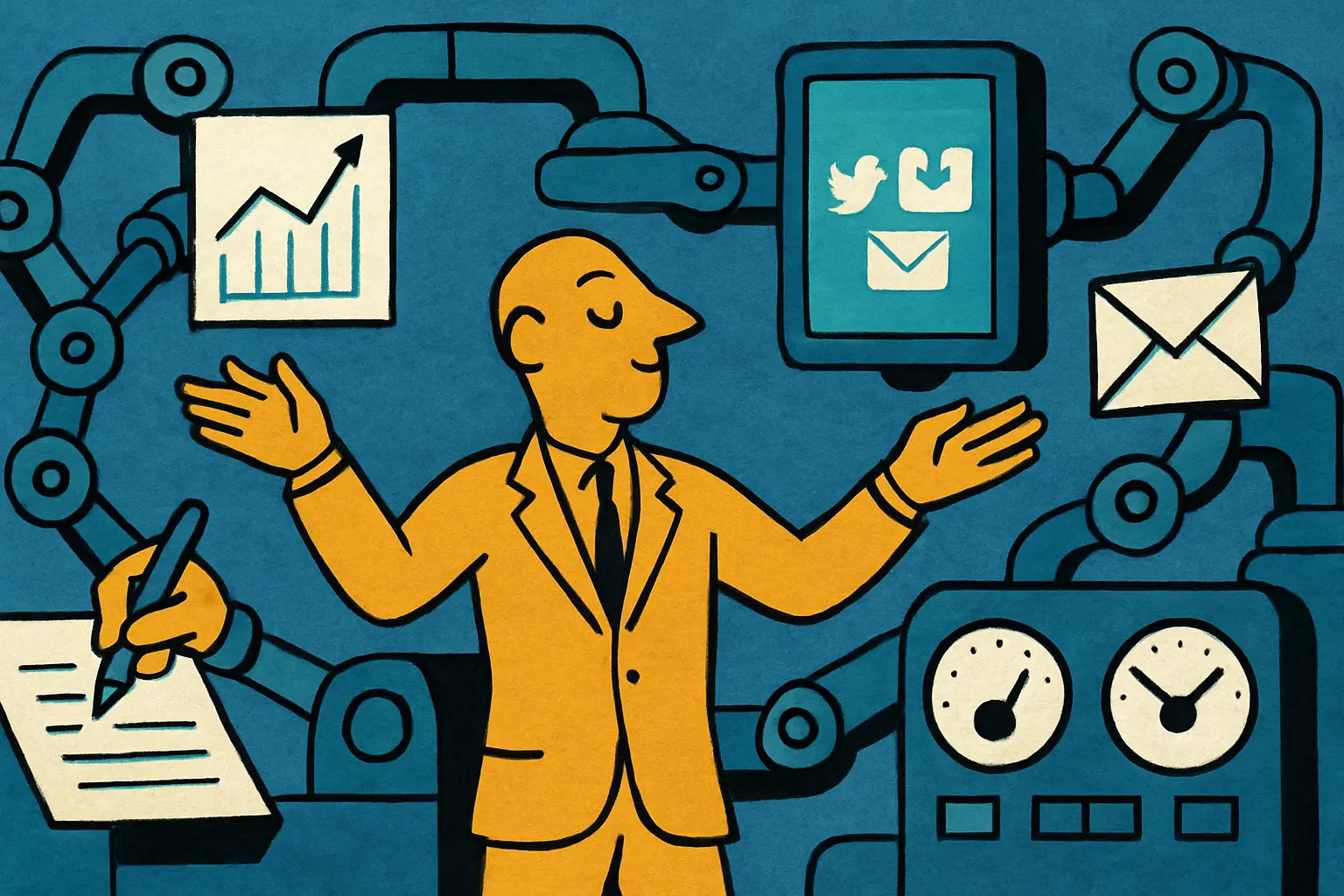
One solopreneur replaced a $17,500-per-month marketing department. Not by hiring offshore. Not by cutting corners. By building an AI-powered operation that handles content production, email automation, social media management, analytics, and CRM from a single desk. The arrangement works like an invisible co-founder: the human sets direction, the machine handles execution, and the output matches what used to require 5 dedicated hires.
The story sounds like an outlier until you look at the economics. CoSchedule's State of AI in Marketing survey of over 1,000 marketing professionals found that 84% of AI-adopting teams report increased productivity with no team size reductions. The marketing automation market has hit $7.3 billion and is projected to nearly double by 2030. The tools are mature, the adoption is near-universal, and the infrastructure is embedded in every major CRM and email platform. But here's the number that matters most: Writer.com reports that only 5% of marketing leaders see genuine business gains from AI. The one-person marketing machine works. It just doesn't work for everyone. The difference between the operators who make it work and those who don't has nothing to do with tools and everything to do with the person running them.
How a One-Person Marketing Machine Actually Works
The theory is interesting. The case studies are more convincing.
Unkoa's analysis of solo marketers scaling with AI profiles two operators who illustrate the model at different stages. Alex Rivera manages 12 client retainers at $750 to $1,000 each, spending under $500 per month on AI tools. His output matches a small marketing team, recovering 9 to 10 hours per client per week through automation. Barbara Jovanovic runs a six-figure agency with no employees, turning a single hour of client input into weeks of branded content by loading branding details into AI systems before prompting. This isn't casual AI usage. It's systematic context engineering: feeding AI enough about the client's voice, positioning, and audience that the output requires editing, not rewriting.
The economics speak for themselves. Rivera's tool stack costs less than $6,000 per year. A junior marketing hire in the US costs $45,000 to $55,000 in salary alone, before benefits, management overhead, and office costs. A marketing department with the roles Rivera covers (content, social, design, analytics, project management) runs $15,000 to $25,000 per month depending on market and seniority. The math doesn't just favor the solo model. It makes the traditional model hard to justify for small and mid-market engagements where budgets don't support full teams.
What's different about operators like Rivera and Jovanovic isn't the tools. It's the workflow discipline. They treat AI as a production layer, not a strategy layer. The weekly rhythm of a functioning one-person marketing machine looks something like this: Monday for strategy, client communication, and campaign planning. Tuesday and Wednesday for content production with AI handling first drafts, image generation, and distribution scheduling. Thursday for analytics review, campaign optimization, and A/B test analysis. Friday for business development, proposals, and networking. One person covering what traditionally required a content writer, a social media manager, a designer, an analytics specialist, and a project coordinator.
The capability gap between a solo operator with AI and one without it is staggering. Multi-channel content distribution, personalized email sequences, real-time analytics, automated social media management — these were enterprise-only capabilities 5 years ago. Now they're available to anyone with $500 per month and the judgment to use them well. BotBorne's analysis of AI marketing automation for solopreneurs confirms the scale: the majority of repetitive marketing tasks can be automated, with operational overhead dropping dramatically when AI handles the execution layer.
But capability and quality are different things. The operators who succeed treat AI output as a raw material, not a finished product. They load brand context before prompting. They implement QA checklists. They're transparent with clients about how content is produced. The one-person machine generates output at scale, but the machinist still decides what's good enough to ship and what gets reworked. That editorial layer is what separates a content operation from a content factory.
The sustainable capacity sits at 5 to 8 clients per solo operator without quality decline, according to Unkoa. Beyond that threshold, even AI-augmented operations start showing strain in areas that AI doesn't fully cover: strategic conversations with clients, relationship management, crisis response, and the creative problem-solving that requires genuine human attention. The one-person marketing machine has limits. But those limits sit comfortably above what any individual marketer could have managed 3 years ago, and the ceiling keeps rising as AI tools move from assistants to autonomous agents.
The progression matters. The marketing automation industry is evolving along a clear trajectory: basic automation, advanced workflows, AI agents, and fully autonomous systems. Most solo operators today sit at phase 2 or 3, meaning the tools handle individual tasks or short workflows. Phase 4, where AI manages end-to-end campaign execution with minimal human oversight, is emerging but not yet reliable. Each phase makes the one-person model more viable and the capacity ceiling higher. The operators building systematic workflows today are positioning themselves to absorb each new capability layer as it matures.
The One-Person Marketing Machine Runs on Strategy, Not Tools
The most useful framework for understanding the one-person marketing machine comes from NxCode's analysis of solo-founded startups in the AI age. They describe a "Vibe CEO" model: 80% strategy, 20% execution. AI handles the execution layer while the human focuses entirely on direction, positioning, and decision-making. Solo-founded startups now represent 36.3% of all ventures, a share that would have been unthinkable a decade ago. The proof case sits in plain view: Midjourney generates $200 million in annual revenue with 11 employees, roughly $18.2 million per head. Revenue-per-employee ratios in AI-native businesses make traditional staffing models look like legacy infrastructure.
Brian Irving, CMO of Lyft, frames the shift through a marketing-specific lens. Writing in Adweek, Irving describes how AI shifted 70% of his staff's effort from data analysis to strategic and creative work. "The more sophisticated our AI tools become at analyzing consumer behavior," Irving writes, "the more human our marketing becomes." AI at Lyft compressed concept visualization from weeks to minutes and revealed emotional drivers behind consumer behavior that traditional analytics missed. The result wasn't fewer marketers. It was marketers doing fundamentally different, higher-value work.
That 70% shift is the real story. AI didn't eliminate Lyft's marketing team. It eliminated the low-value work that consumed most of their time and redirected capacity toward the work that moves metrics. For a solo operator, the same principle applies at individual scale. AI handles the production: drafting content, analyzing data, scheduling posts, generating variations, running A/B tests. The human handles what AI cannot: understanding the audience, making strategic trade-offs, reading cultural signals, and knowing when good enough isn't.
The investment community sees it too. Peak Capital's analysis of AI-powered solopreneurship points to WhatsApp's $19 billion acquisition with only 55 employees as the precedent, roughly $345 million per employee. AI extends this extreme efficiency model beyond tech startups into professional services, including marketing. When VCs recognize the pattern, it's structural, not anecdotal. Team size is no longer a proxy for capability, and the shift from "how big is your team?" to "how capable is your AI stack?" is already rewriting how capital evaluates service operations.
What this means for the marketing industry is profound. The question senior leaders should be asking isn't whether AI will change their team structure. That's already happening. The question is whether they're building the strategic capability to direct these machines, or just deploying tools without a driver.
Why 95% of AI Marketing Machines Are Getting It Wrong
Here's where the narrative gets uncomfortable.
Writer.com's analysis of AI adoption reveals a stark gap between productivity and results. Only 5% of marketing leaders report genuine business gains from AI. Not productivity gains. Not speed improvements. Not "we're producing more content." Actual, measurable business impact that shows up in revenue, customer acquisition, or market share.
Set that against the near-universal productivity increases across the industry and the contradiction becomes the most important data point in this article. If the vast majority of marketers are more productive with AI but almost none see business results, something is broken between output and outcome. Speed without strategic direction produces more mediocrity faster. AI amplifies whatever approach you feed it, including bad ones. The bottleneck has shifted from "how to produce content" to "what content to produce," and most organizations haven't made that mental adjustment.
This is the trap. AI removes the production bottleneck. Content that took a week takes a day. Campaigns that required three people require one. But if the strategy behind that content was weak before AI, now you're executing a weak strategy at 10 times the speed. The bottleneck didn't disappear. It moved upstream, from production capacity to strategic judgment. And strategic judgment doesn't scale with tools. It scales with experience.
I've watched this pattern play out across two decades of marketing leadership. New technology arrives, organizations rush to adopt it, and the ones who win aren't the earliest adopters, they're the ones who understood what to do with the technology before they turned it on. Email marketing, social media, programmatic advertising, marketing automation, every wave followed the same script. The technology democratized access to a capability. Then the market rewarded the operators who paired that capability with strategic clarity and punished the ones who mistook the tool for the strategy.
AI is the same movie on a bigger screen. The production layer is now nearly free. That makes the strategy layer the only remaining differentiator. For organizations relying on AI-augmented teams without strategic direction, the tool makes things worse, not better. More content, more campaigns, more noise, less impact per unit of effort. For experienced operators who bring genuine strategic capability to AI-powered execution, the competitive advantage is enormous. They operate in a market where 95% of competitors are producing volume without direction while they produce fewer, better-targeted campaigns with measurable returns.
For the one-person marketing machine, this is counterintuitively good news. The competitive moat isn't access to AI tools. Everyone has those. The moat is the ability to point those tools in the right direction. A senior marketer with 15 years of campaign experience, audience intuition, and brand understanding running AI-powered execution is a fundamentally different proposition than a junior operator prompting ChatGPT and hoping for the best. The 80/20 model works precisely because of this gap. The 20% execution layer is commoditized. The 80% strategy layer is where experience compounds. Every failed campaign, every budget reallocation, every market pivot a marketer has lived through becomes input that AI cannot replicate and junior operators cannot shortcut.
The One-Person Marketing Machine Goes Global
The one-person marketing machine isn't a Silicon Valley phenomenon. It's global, and the expansion is accelerating.
Halper AI's expansion to Latin America demonstrates the model's geographic reach. The platform saves solopreneurs 35 hours per month by automating customer communications across WhatsApp, Instagram, and Telegram, the dominant business channels in LATAM markets. Halper ranked 4th among AWS startups globally and holds partnerships with Meta and Nvidia, institutional validation that the solopreneur AI tools market has substance behind the hype.
This matters because LATAM solopreneurs operate under different constraints. Smaller budgets. Fewer enterprise-grade tools designed for Spanish and Portuguese. Business communication happening on WhatsApp rather than email. Customer expectations shaped by messaging-first culture, not web-first. The fact that AI solopreneur tools are purpose-built for these channels means the one-person model isn't limited to operators with access to premium US-market tooling. LATAM solopreneurs aren't chasing the same KPIs as their US counterparts either. Halper positions its users as "chasing freedom, not engagement," a framing that shapes entirely different business structures and growth trajectories than the Silicon Valley scale-at-all-costs playbook.
Marketing strategist Mark Schaefer argues that AI fundamentally democratizes entrepreneurship. The economic constraints that made solo marketing operations impractical in emerging markets are dissolving. A marketer in Buenos Aires, São Paulo, or Mexico City now accesses the same AI capabilities as their counterpart in Boston or London. The barriers that previously required teams or capital (content production, multi-channel distribution, analytics, personalization) are now handled by tools that cost less than a single employee's monthly salary.
For organizations sourcing marketing services, the implications are immediate. The talent pool for capable one-person marketing operations now spans geographies and time zones. A senior marketer with deep strategic experience, AI fluency, and cultural understanding of multiple markets can deliver what previously required a localized team in each region. The one-person marketing machine doesn't just reduce cost. It removes geographic friction from the talent equation entirely.
The buyer resistance is nearly gone. The vast majority of companies are open to AI-powered marketing services. When the tools are globally available, the strategic talent runs international, and the market is ready, the one-person model stops being an experiment and starts being the default for small-to-mid-market marketing engagements.
Every Marketing Machine Needs a Machinist
The one-person marketing machine is real. The tools work. The economics are proven. Solo operators are already delivering team-level output across content, analytics, email, social media, and paid campaigns.
But the machine doesn't run itself. That 5% statistic from Writer.com is the sharpest reminder: the vast majority of marketers adopting AI see no meaningful business gains. The difference between the 5% who do and the 95% who don't isn't the technology. It's the strategic judgment of the person operating it. Knowing which campaigns to run, which audiences to prioritize, which metrics actually matter, and when to override the AI's recommendations with hard-won instinct.
What changes in the next 2 years is the execution layer, not the strategy layer. AI agents will handle more complex workflows. Autonomous campaign management will mature. The tools will get smarter, cheaper, and more integrated. None of that changes the fundamental equation: someone still needs to decide what the machine should build, for whom, and why. The operators who invest in that strategic capability now are the ones who will absorb each new wave of automation without missing a step.
The era of the one-person marketing machine doesn't make experienced marketers obsolete. It makes them more valuable than they've ever been. AI commoditized execution. Strategy is what's left. And strategy has always been a function of experience, not headcount.
Sources
- One-Person Agency, 10x Output: How Solo Marketers Use AI to Scale
- AI Isn't Replacing Marketers — It's Making Us More Human
- State of AI in Marketing Report 2025
- How Marketing Automation & Agentic AI Are Reshaping Business Growth
- AI Agents for Solopreneurs: Building Empires in 2026
- The Rise of Solo-Founded Startups in the AI Age
- The State of AI in Content Marketing 2025
- Solo-Operated, AI-Powered Businesses: The VC Perspective
- Halper AI Expands to Latin America for Solopreneurs and SMEs
- How Solopreneurs Are Quietly Scaling with AI in 2025
- AI Solopreneurship