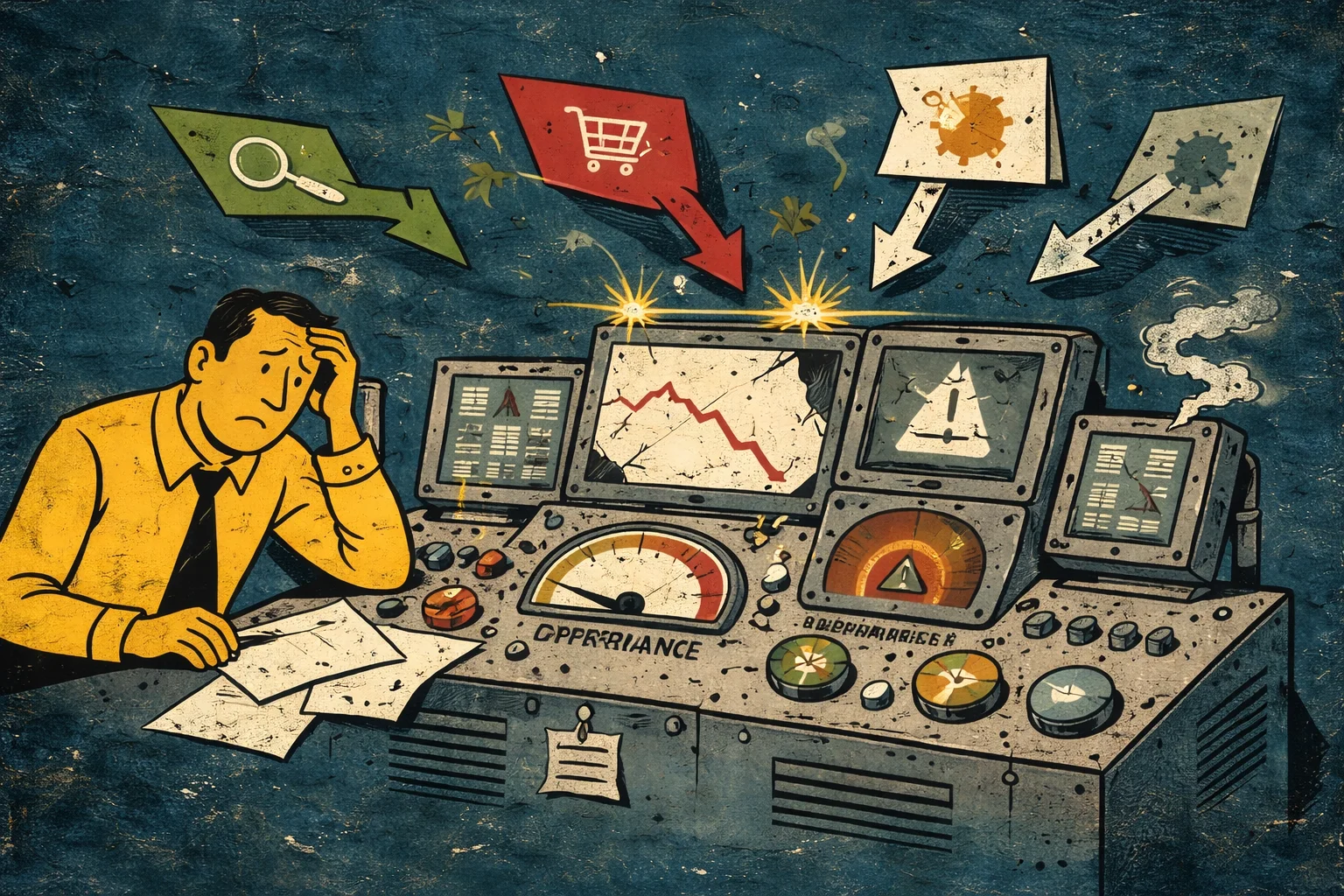
Your marketing budget didn't change. Your team is still executing. The campaigns are running. But the results that used to come in have quietly thinned. Leads cost more, organic traffic declines month over month, and the pipeline that once felt predictable now feels like guesswork. Something broke, and it wasn't your effort.
Marketing strategies have a shelf life. They decay because markets shift, buyers change how they discover and evaluate, competitors adapt, regulations evolve, and channels restructure. The strategies that produced results in 2022 and 2023 were designed for an era of reliable Google search traffic, third-party cookie tracking, and buyer journeys that followed predictable funnels. That era ended. Companies still running those playbooks are experiencing the consequences.
Why Did Your Marketing Playbook Stop Working?
Three structural changes converged in 2024 and 2025 to invalidate marketing strategies that had worked for years. Understanding which ones hit your business explains what needs to change.
How Has AI Changed the Way People Discover Brands?
The most dramatic shift is in discovery. Entrepreneur's analysis of why current marketing strategies fail identifies the core problem: "Discovery isn't happening solely on Google; it's happening across AI assistants, social platforms and video environments." Companies that optimized exclusively for Google search now miss where their customers actually look.
The data from Dataslayer quantifies the damage. Queries where Google's AI Overviews appear show a 61% decline in organic CTR, dropping from 1.76% to 0.61%. Paid search fared even worse, with CTR crashing 68% from 19.7% to 6.34% on AI Overview queries. In one documented case, impressions climbed 27.56% year-over-year while clicks dropped 36.18%. More visibility, fewer clicks. The traffic that once justified entire marketing budgets is structurally thinner.
But here's the nuance that matters: brands that appear within AI Overviews earn 35% higher organic CTR and 91% higher paid CTR compared to competitors on the same queries. The channel isn't dead. The rules changed. Visibility moved from ranking position to citation inclusion, and most marketing strategies haven't caught up.
Campaign's analysis of 2026 marketing trends puts the scale in context: over 1 billion people now engage with generative AI monthly. Their Digital 2026 report suggests AI could eclipse search engines and social feeds as the primary way people access information. For companies whose marketing strategy was built around search-first discovery, this isn't a gradual decline. It's a structural displacement.
Buyer Behavior Changed Faster Than Marketing Adapted
The second shift is in how buyers make decisions. B2B Growth Essentials' research, drawing on McKinsey's B2B Pulse data, shows that 20% of decision-makers already use generative AI to research and shortlist suppliers, with another 23% exploring AI applications in their buying processes. Buyers now engage across an average of 10 interaction channels, up from 5 in 2016.
What they lack isn't access to information. It's trust in what they find. 67% of consumers expect personalized interactions, but only 26% believe AI delivers effective personalization. The tools are deployed. The execution falls short. Marketing teams built for a world where buyers followed a sequential funnel (awareness, consideration, decision) with a human sales handoff now face buyers who complete their evaluation across invisible digital channels, often before any sales contact occurs. The gap isn't data or technology. It's the strategic capability to meet buyers where they actually are, with content that earns trust rather than just fills a channel.
Why Is Marketing Effectiveness Declining?
The third shift is internal to the marketing profession. Marketing Week's 2025 Career & Salary Survey of 3,500 marketers reveals that 60.5% identify marketing effectiveness as the biggest skills gap in their organization. The profession is losing the skill it needs most at the moment it needs it most.
Rachel Moss, Head of Marketing Strategy at Allwyn, defines it plainly on the Marketing Week podcast: "Marketing effectiveness is marketing delivering value for the business by meeting consumer needs." But Moss argues the industry has narrowed the term to advertising and media effectiveness, ignoring the other three P's. When effectiveness conversations focus only on media ROI and ad spend returns, marketers miss the levers that might actually move the business: product experience, packaging, distribution, pricing strategy.
This narrowing creates a disconnect between what marketers measure and what the business needs. Teams report on campaign performance, channel metrics, and engagement rates. The C-suite asks about revenue growth, customer acquisition cost, and market share. The two conversations happen in parallel but rarely intersect. Marketers who can't bridge that gap get reduced to what MarTech calls "custodians of optics," producing reports that look impressive but explain nothing about business outcomes.
The skills gap compounds the problem from the bottom up. The same Marketing Week survey found that over half of respondents report a performance marketing skills gap. 46% identify social media as a gap. Junior marketers are spread too thin to learn foundational skills properly. As Molly Innes, Senior Reporter at Marketing Week, observed: "Cost cutting is cutting experience and actually junior people are losing skills by over-relying on AI because they have to." The result is teams that can execute tactics but can't connect those tactics to strategy, and leaders who measure activity because they've lost the capability to measure outcomes.
This creates a compounding problem. Less effective marketing produces weaker results, which triggers budget pressure, which reduces the capacity to invest in the strategic capabilities needed to adapt, which produces even weaker results. The cycle breaks only when someone asks whether the strategy itself needs replacing, not just the tactics within it.
Why Does Performance Marketing Stop Producing Results?
Performance marketing stops producing results when it exhausts the available demand without replenishing it. MarTech's analysis frames the problem with precision: "Performance marketing doesn't create demand. It captures it." When brands exhaust existing demand through performance tactics, growth stalls because the pipeline isn't being replenished.
Reid Holmes, writing in MarTech, describes the result as the "plateau of indifference," a state where brands are known but unmotivated. Awareness exists. Preference doesn't. The brand competes on price because it hasn't built meaning. The data is clean. The dashboards are humming. Yet the return from tactics that used to produce reliably has thinned to a fraction of what it once delivered.
Research from Les Binet and Peter Field shows that growth stalls when brands lean too heavily toward performance marketing at the expense of brand building. Only 5% of buyers are in-market at any given time. The other 95% are forming impressions, building mental availability, and developing the associations that will shape their eventual purchase decision. Performance marketing reaches the 5%. Brand building shapes the 95%. Companies that cut brand investment to fund more performance spend eventually exhaust the small pool of current-intent buyers and wonder why conversion costs keep rising.
The AI disruption amplifies this. Gartner's projected 25% search volume decline means the pool of capturable demand is shrinking structurally. Companies spending more on search ads to capture a shrinking pool of queries are paying more per result and calling it a campaign problem. It's a market problem, and it explains why marketing stopped working for companies that relied on search as their primary channel.
Your Dashboard Is Lying to You (Politely)
Most marketing dashboards measure activity, not business impact. Two-thirds of marketers can't define the technical foundations of their own craft, according to Mark Ritson's research. The measurement crisis runs parallel to the strategy decay. MarTech's analysis characterizes many marketing organizations as "custodians of optics," monitoring dashboards that produce no real intelligence, measuring motion rather than momentum.
This isn't about tool complexity. It's about the gap between what marketing teams report and what the business actually needs from them. Teams fill the gap with activity metrics: impressions served, emails opened, content published, followers gained. These metrics are visible, countable, and consistently positive. They're also disconnected from revenue.
The proposed fix is structural alignment across three domains: Business (unit economics, market viability), Marketing (product validation, brand promise delivery), and Sales (conversion velocity, revenue generation). Most teams try to "creative-campaign" their way out of problems that live in the gaps between these pillars. A marketing strategy that doesn't connect to business unit economics and sales conversion is a communications plan, not a growth engine. The distinction matters because it determines what you measure, what you invest in, and what you hold accountable.
What to Do When Marketing Stops Working
If the dashboard measures motion and the C-suite needs momentum, the gap isn't a reporting problem. It's a strategic one. Marketing strategies that stopped working don't need more budget. They need a diagnostic.
The Growth Syndicate's marketing audit framework operates across three levels. The strategic level assesses alignment with business goals, ICP accuracy, positioning differentiation, and whether marketing goals connect to revenue growth. The functional level evaluates team organization, resource allocation, brand consistency, and the sales-marketing alignment that determines whether leads convert or die. The technical level reviews channel-by-channel performance, ROI metrics, conversion tracking, and whether the data actually measures what matters.
The framework produced measurable results in practice. Frends, a B2B technology company, increased MQL-to-SQL conversion from 14% to 25-30%, tripled website CTR from 0.18% to 0.54%, and generated 24 direct opportunities through focused ABM implementation after their audit. The improvement came not from spending more but from redirecting spend toward what actually worked.
The audit discipline should happen at least annually, with quarterly reviews on performance indicators and immediate reassessment when trigger events occur: a major competitor move, a platform change (like AI Overviews rolling out to your category), or a sustained decline in conversion rates across channels.
How Long Does a Marketing Strategy Last?
Marketing strategies typically need review every 12 to 18 months, with immediate reassessment when major market shifts occur. Every marketing strategy is a bet on a specific set of market conditions. When those conditions change, the strategy's returns decay. This is normal and inevitable. The mistake is treating a strategy as permanent infrastructure rather than a living system that requires periodic validation and adjustment.
The companies whose marketing still works in 2026 share one discipline: they review their strategy against the current market, not the market they built it for. They ask whether their discovery channels still reach their buyers, whether their measurement captures what the business needs, whether their content earns attention in a world flooded with AI-generated noise, and whether their brand carries enough weight to compete on meaning rather than price.
The companies whose marketing stopped working ask none of those questions. They optimize tactics within a strategy that no longer fits the terrain. They work harder inside a system that's pointed at the wrong target. They measure activity because they can, and they avoid measuring outcomes because the numbers would force a conversation they're not ready for.
Marketing stops working when the strategy expires and nobody notices. The fix is noticing.
Sources
- Why Your Current Marketing Strategy Won't Hold Up in 2026
- Why Performance Marketing Stops Working
- Gartner: Search Engine Volume Will Drop 25% by 2026
- AI Overviews: The End of Traditional CTR
- Focus on Marketing Effectiveness in Decline
- What Stays, What Changes, What Breaks: Trends Shaping Marketing in 2026
- How AI Is Reshaping B2B Buyer Behavior
- Marketing Audit: What It Is, How to Conduct One
- How Can Marketing Fix Its Effectiveness Skills Gap? — Marketing Week Podcast