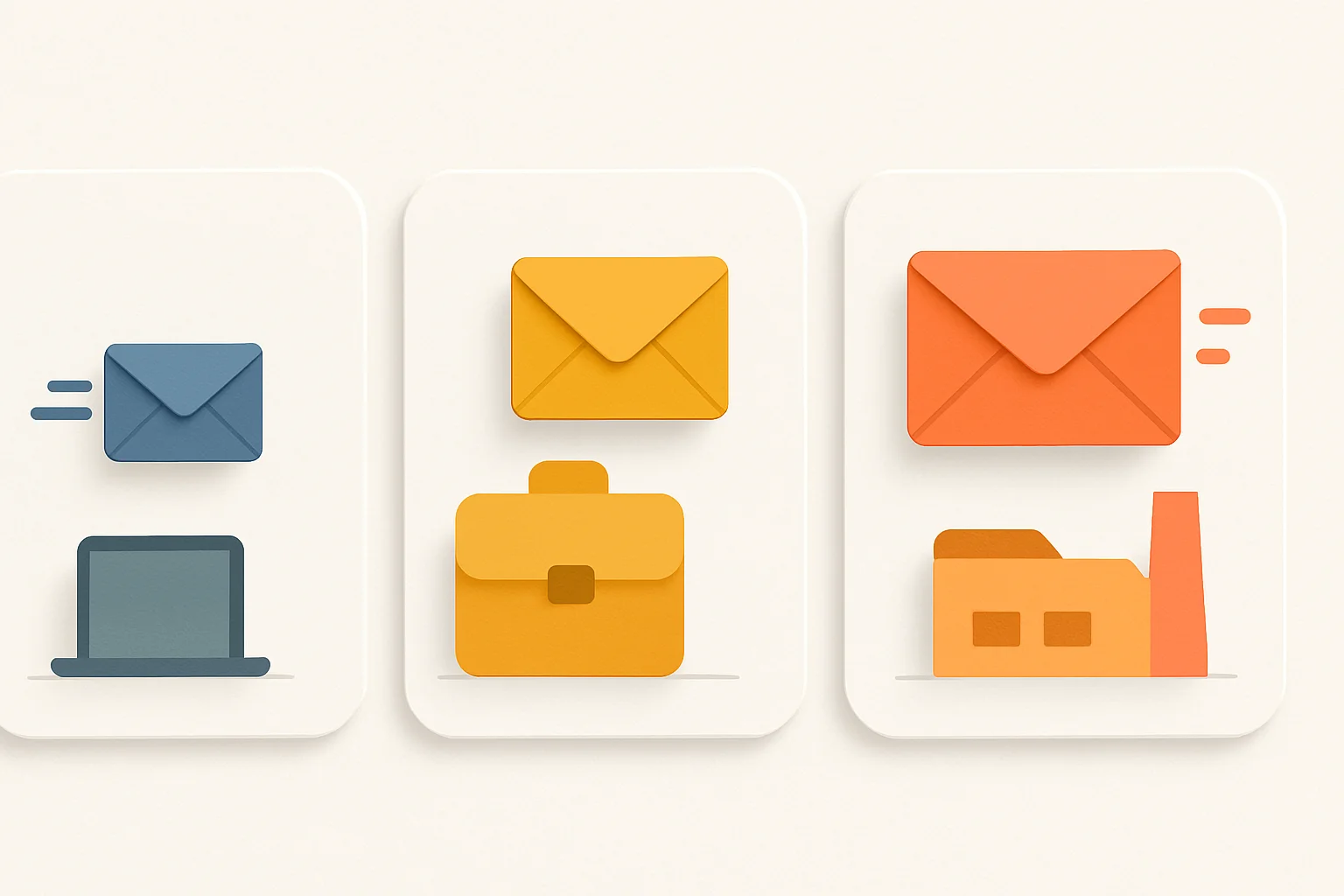
Most cold outreach programs are built from the same playbook: buy a list from Apollo, load it into Instantly, write a 4-email sequence, and send 500 emails a day. That playbook works, but only if you're selling a $99/month SaaS tool to marketing managers. It falls apart the moment your business doesn't look like that.
The outreach industry has a dirty secret: the vast majority of agencies, tools, and "proven frameworks" were designed for one specific business model: high-volume, low-friction, single-decision-maker SaaS sales. If you sell professional services, project-based work, or anything with a technical buyer in the loop, you've probably been handed a process that was never meant for you. And then been told "outreach doesn't work in your industry" when it predictably underperformed.
It does work. It just doesn't work the same way.
Why does cold outreach fail for non-SaaS businesses?
Short answer: Most outreach programs are built around one business model (recurring-product SaaS sales) and fail when applied to businesses with larger deals, longer sales cycles, or multiple decision-makers. The failure isn't the channel. It's the architecture.
When outreach vendors talk about "customizing" a program, they usually mean swapping your company name into the same templates. But the differences that actually matter have nothing to do with branding. They come down to two questions:
How big is the deal, and how many people need to say yes?
A SaaS product at $500/month is a credit card purchase. One person decides, often in a single meeting. A $15,000/month agency retainer requires trust, a track record, and usually a conversation with someone's boss. A $50,000 custom electronics order involves an engineer who specifies, a procurement team that negotiates, and an executive who approves, and the whole process takes six months.
These aren't minor differences. They change everything: who you contact, what you say, how often you reach out, what channels you use, and what counts as success.
What are the four outreach archetypes?
Short answer: Four business-model archetypes predict how an outreach program should be built: the Recurring Product Sale (SaaS), the Service Engagement (agencies/consulting), the Defined-Scope Project (implementation work), and the Technical/Industrial Sale (manufacturing/enterprise hardware). Each requires a different volume, channel mix, and conversion definition.
After running and studying outreach programs across industries, we've identified four distinct archetypes that predict how an outreach program should be built. The infrastructure is shared: domains, warmup, deliverability, and compliance are universal. What changes is everything above that foundation.
The Recurring Product Sale
This is the SaaS model: $200-2,000/month, one decision-maker, 1-4 week sales cycle. The playbook is volume and efficiency. You can run 200-500 emails per day because the ask is small, the buyer is accessible, and personalization at Level 1-2 (name, company, one relevant signal) is enough to get a response. The conversion event is a demo or trial. This is where most outreach tools and agencies live, and they're good at it.
Published 2026 benchmarks put average SaaS cold email reply rates at 1.87-3.5%, with well-executed, tightly-targeted campaigns reaching 5-8%. Meeting booking rates in those well-run programs sit at 1.5-2.5%. The math works when you're playing a numbers game with a high-velocity funnel and the targeting is sharp.
The Service Engagement
This is the model for agencies, consultancies, and staff augmentation firms: $5,000-20,000/month, one to two decision-makers, 2-8 week sales cycle. The playbook shifts from volume to credibility. Your prospects can sense a templated pitch from three paragraphs away, and they get dozens of them every week.
What works here is multi-channel sequences where LinkedIn carries equal weight to email, content integration (sharing a relevant case study or framework mid-sequence), and Level 2-3 personalization that references the prospect's specific situation. The conversion event isn't a "demo". It's a strategy call or an audit. You're selling your thinking before you sell your services.
Daily volume drops to 50-150 emails because every message needs to carry weight. But the trade-off is worth it: in the programs we've run, proposal-to-close rates land in the 25-40% range, compared to 15-25% for SaaS, because the people who agree to talk actually have a need.
The Defined-Scope Project
This is newer territory. Think AI-assisted software development, implementation projects, or consulting engagements in the $20,000-100,000 range with 3-12 week timelines. The buyer profile looks like a service engagement (CTO, VP Product, VP Engineering), but the conversation is different. You're not selling an ongoing relationship; you're selling a specific outcome with a defined scope.
Outreach here needs to lead with speed and specificity. "We built X in 4 weeks" is more compelling than "we have 200 engineers." The prospect needs to believe you can scope accurately, deliver quickly, and not turn a $30K project into a $150K quagmire. Case studies with real timelines and budgets are the most effective content asset.
The interesting math: because the commitment is bounded (a 4-week project, not a 12-month contract), we've seen meeting-to-proposal conversion in the 50-70% range. Prospects explore because the downside is limited.
The Technical/Industrial Sale
This is custom manufacturing, enterprise hardware, and specialized equipment: $50,000-500,000+, three to five decision-makers, 3-12 month sales cycles. This is where the standard outreach playbook collapses most dramatically.
The decision-makers, engineers and procurement officers, are often not active on LinkedIn, poorly indexed in Apollo or ZoomInfo, and generally unreceptive to the "quick question" email format that works in SaaS. The signals that trigger outreach are completely different: new product development announcements, regulatory changes requiring component redesign, supply chain disruptions forcing vendor switches. These signals come from trade publications, patent filings, and conference attendee lists, not from G2 intent data.
Outreach volume drops to 10-30 highly targeted emails per day, with phone becoming the dominant channel after initial contact. The conversion event isn't a meeting. It's getting on the approved vendor shortlist. Email response rates run 3-5%, the lowest of any model, but a single conversion can be worth $100K+.
How do I know if an outreach vendor understands my business?
Short answer: Ask them to describe your business model in outreach terms and explain how their approach changes based on your deal size, sales cycle, and decision-making process. If they can't distinguish between a $99/month SaaS sale and a $50,000 custom manufacturing order in how they'd build a program, they'll build the wrong program for you.
If an outreach vendor shows you a pitch that includes phrases like "we'll send 1,000 emails per day" and "our proven 4-step sequence" without first asking detailed questions about your deal size, buyer profile, sales cycle, and conversion definition, they're selling you Archetype A regardless of what your business actually looks like.
That doesn't make them bad at what they do. It makes them wrong for you.
The questions to ask are not about tools or technology. They're about whether your outreach partner understands that a custom electronics manufacturer needs a fundamentally different approach than a SaaS startup, and can articulate exactly how and why.
The infrastructure (domains, deliverability, compliance) is table stakes. Any competent agency handles that. The differentiation is in the strategy layer: targeting logic, signal identification, sequence architecture, and channel mix. If your vendor can't explain how these change for your specific business model, they're running a cookie-cutter program with your logo on it.
The Bottom Line
Cold outreach works across all four archetypes. The response rates are different, the timelines are different, and the channel mix is different, but the ROI is there in every case when the program is designed for the actual business model it serves.
The most expensive outreach program isn't the one with the highest monthly retainer. It's the one that was built for the wrong archetype and spent three months sending SaaS-style email blasts to procurement directors who will never respond to them.
B2X Marketing helps clients design outreach programs grounded in research on how different purchase cycles and business models demand different approaches. If you're evaluating outreach partners, here are the 10 questions to ask before you sign.