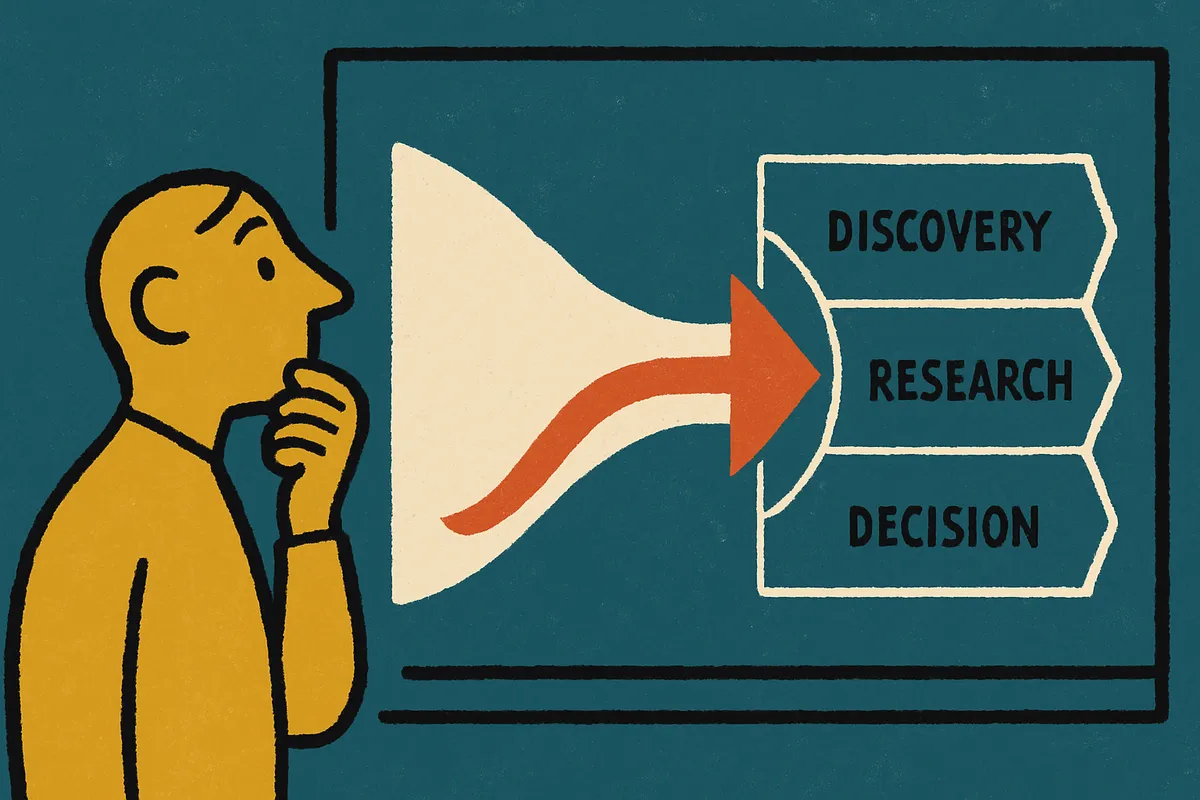
The Funnel Changed Shape: Mapping the Discovery → Research → Decision Journey for SMBs
51% of B2B software buyers now start their research with an AI chatbot rather than Google. 7 months earlier, the number was 29%. That single shift, documented in G2's 2026 AI Search Insight Report, breaks more than a metric. It breaks the assumption that the marketing funnel still describes how the B2B buyer journey actually works.
The funnel did not die. Most of the work it organized still happens. Buyers still become aware, evaluate options, and choose vendors. What changed is the shape of the path between those stages and where the work happens. SMB founders feel this as a thinning pipeline they cannot explain. They are running the same playbook that worked three years ago, and it is producing less. The problem is not effort. The problem is geography. They are still showing up where the funnel used to live, while buyers are forming preferences somewhere else.
What Does the Traditional Marketing Funnel Still Get Right?
The traditional marketing funnel remains useful for planning and as a shared vocabulary, even though it no longer describes how buyers actually move from awareness to purchase.
Nikhil Lai, Principal Analyst at Forrester, made the most useful argument in this category in 2024: the funnel does not describe how buyers actually behave, but it remains valuable as a planning lens and a shared vocabulary. "No two buyers' journeys are alike," Lai writes. Modern buyers move across search, social, mobile, email, and peer conversations in unpredictable order. Forcing those journeys into a linear funnel produces a clean diagram and a misleading map.
That distinction matters for SMBs more than for enterprise marketers. Enterprise teams have the headcount to build sophisticated attribution stacks that bypass the funnel's behavioral inaccuracy. SMBs do not. When the funnel breaks as a behavioral description, SMBs are the ones who feel it first, because they cannot afford the instrumentation that would tell them what is actually happening.
What replaces it is not a new linear model. It is a more honest description of three stages that still exist, just not where marketers were looking. Discovery, Research, and Decision. Each one operates differently than it did five years ago. Each one needs different instrumentation. None of them is fully trackable, and that is the point.
Discovery: Where the Shortlist Forms Before You Know It Exists
Discovery used to mean impressions. A buyer saw an ad, a search result, a piece of content, and the brand entered consideration. Dreamdata's Stephanie Dean describes what replaced it: an ambient, passive process that happens in social feeds, podcasts, Slack communities, and peer conversations. By the time a buyer starts what looks like research, the shortlist has substantially formed.
Daniel Murray, quoted in Dreamdata's analysis, puts it directly: "The decision period is getting shorter because the preference formation period is happening earlier, and mostly out of sight." That observation reframes the entire top of the funnel. Reach and impressions are not wrong as concepts, but they measure visibility in channels that increasingly do not matter. What matters is presence in conversations and feeds that large language models (LLMs) and human peers reference when buyers eventually do start active research.
The data on where those conversations happen is striking. According to eMarketer, only 8% of ChatGPT citations come from Google's top 10 organic results. Reddit accounts for 40.1% of all generative AI citations worldwide. Wikipedia adds 26.3%. YouTube contributes 23.5%. An SMB with a clean SEO setup can still be invisible to AI-mediated research because the citations that drive AI answers come from community platforms, not from optimized product pages.
Two-thirds of US consumers now use social media for search, eMarketer reports. Nearly 40% of Gen Z uses TikTok and Instagram instead of Google. The B2B implications are direct: discovery is no longer a category of media spend. It is a category of presence, and the asset that wins it is sharability. Dean's framing is useful: "A like is passive approval. A share is a signal of care." For SMBs without budget for paid awareness campaigns, sharability is a more realistic Discovery-stage signal than impressions, because it can be earned by content that names a real problem.
A practical implication follows. The Discovery work an SMB founder can actually do, without an agency or a budget, is publish opinionated content in the categories where their buyers form preferences. That is not a content marketing recommendation. It is a presence recommendation. If the founder is the most credible voice in the company, the founder's LinkedIn feed is the discovery surface. If the company has subject-matter experts, their participation in industry communities is the discovery surface. None of this shows up in standard analytics. All of it shows up in the shortlist.
Similarweb's analysis includes a concrete example. An HR tech company hired a community manager whose only job was to participate authentically in professional Slack communities where the company's buyers were active. Within two quarters, "community" began appearing as a source in post-sale interviews. The investment was a single community-manager hire and a posture of showing up. For an SMB, the equivalent is a founder spending two hours a week in the two communities that actually matter, rather than four hours posting into the void on the wrong platforms.
Research: From Reference to Inference
If Discovery happens in feeds, Research happens in AI. G2's report, authored by Chief Innovation Officer Tim Sanders, surveyed over 1,000 B2B decision-makers and found that 71% rely on AI chatbots somewhere in the research process. Fifty-four percent cite AI chatbots as the number one source influencing their vendor shortlists. Sixty-nine percent report being led to a different vendor than they initially planned. Thirty-three percent purchased from a vendor they had never previously heard of, surfaced entirely by AI.
Sanders calls this shift "from reference to inference." Buyers no longer request sources. They demand synthesized recommendations. That is a different request, and it requires a different visibility strategy. Roi Kaufman, VP of Demand Generation at Similarweb, quantifies how invisible most of this Research-stage activity is to traditional analytics: 73% of the B2B buying journey now happens anonymously, in private communities, AI queries, peer conversations, and dark social. Similarweb's data shows that direct traffic, long treated as "organic" or "branded," is primarily dark social misattributed. SparkToro found that 100% of traffic from Slack, Discord, and WhatsApp appears as "direct" in standard analytics.
Apollo's 2026 buyer journey roundup adds a stat that should reshape SMB strategy: B2B buyers engage 22% fewer vendors per purchase than two years ago, down from 3.2 to 2.5 on average. Buyers also consume 13.4 pieces of content before contacting sales, up from 11.6 in 2024. More content, fewer vendors, faster shortlists. The shortlisting bar is higher, and most of it is happening in places SMB marketing does not measure.
Trevor Pyle, Head of Marketing at Profound, summarized the operational gap in G2's report: "Buyer behavior has moved faster than their instrumentation." That is the diagnosis SMBs need to hear plainly. The pipeline is not thinning because marketing is doing less. It is thinning because the work is happening in channels the analytics never tracked, and the buyer's vendor shortlist is now narrower than it has ever been. The Research stage rewards visibility in two places at once: in the AI tools buyers use to shortcut their reading, and on the review and community platforms those tools cite.
Similarweb's analysis includes a case that captures the gap viscerally. A 300-person logistics SaaS had zero intent-data signals showing the account was researching them. The buying group was silently evaluating the company through recommendations in the Pavilion Slack community and through AI-generated category comparisons. When the deal eventually surfaced, it had already been signed with a competitor. The vendor never had an opportunity to influence the Research stage because they were invisible in the channels where it happened. For an SMB, the same dynamic plays out at smaller scale every quarter and shows up as "deals we never knew about" and "we lost to someone we'd never heard of."
Decision: When the Buyer Owns the Process
The Decision stage is now buyer-owned. Sixty-seven percent of B2B buyers prefer a rep-free purchase experience, and 80% of the decision happens before any seller enters the conversation.
Gartner's sales survey, published in March 2026 and based on responses from 646 B2B buyers between August and September 2025, found that 67% prefer a rep-free purchase experience. Gartner also predicts that 1 in 5 purchases will be completed by an AI agent in 2026. Boobesh Ramadurai, VP at LatentView Analytics, frames the strategic implication in MarketingProfs: "The challenge shifts from persuasion to visibility, with machines potentially determining what humans encounter next." Eighty percent of B2B decision-making happens before a seller enters the conversation, by Ramadurai's count.
For SMBs, the Decision stage looks different than the Gartner numbers suggest at first glance. Most SMB founders do not have sales teams. They are the sales team. The "rep-free preference" is not a structural threat to a 12-person company. It is the default condition. The pressure is to instrument what the buyer does when they self-serve their way to a purchase decision, because the founder is not in the room when most of that happens.
Apollo's data exposes the other half of the Decision-stage problem: 86% of B2B buyers report purchase stalls. Most deals do not fail on price or fit. They fail on inertia. That stall rate matters more for SMBs than the rep-free preference because the deals that thin a pipeline are not the ones that go to a competitor. They are the ones that go nowhere.
There is a useful counterpoint here. Apollo also found that companies offering both rep-led and self-service options are 3.9x more likely to exceed profit growth expectations. Gartner's own projections add a temporal nuance: by 2030, the firm predicts 75% will prefer human interaction. The current rep-free era may be a transition state, a response to poor sales experiences rather than a permanent preference shift. For SMBs, the practical read is that buyer-owned self-service should be instrumented, but a quality human touch at the right moment still wins the kind of deals that close. The founder who answers a chat reply at 9pm and follows up with a real diagnosis call is not competing with the rep-free preference. They are exactly what the rep-free preference is asking for.
Why Is B2B Attribution Missing Most of the Buyer Journey?
Most B2B attribution tools were built for a buying journey that no longer exists. Seventy-three percent of the B2B buying process now happens in AI queries, private communities, and dark social, none of which click-based tracking reaches.
A reasonable reader at this point might think: fine, the journey has changed, but the instrumentation problem belongs to enterprise marketing teams with their attribution stacks. That read misses the size of the gap.
A 2026 IAB/BWG Global report, covered by Constantine von Hoffman at MarTech, found that 75% of marketers say their measurement systems fail to deliver speed, accuracy, and reliability. Sixty-seven percent still rely on last-touch attribution. The average B2B software transaction involves 266 touchpoints, and click-based tracking captures less than 0.5% of them. Chris Walker, CEO of Refine Labs, put the structural problem in Similarweb's analysis: "Attribution software fails to measure communities, word of mouth, and podcasts at all. You need an additional layer."
Maddie Shepard and Bobby Hare, writing for B2B Marketing Brief, argue that the fix is not to abandon attribution but to expand it. They propose a three-layer architecture: a unified account identity layer that ties anonymous activity to known accounts, stage-based measurement that tracks engagement at each phase of the journey, and an AI visibility layer that monitors how often the brand appears in generative AI answers. Shepard's framing is direct: "The future of measurement isn't about abandoning attribution models. It's about expanding them."
Chris Golec, CEO of Channel99, adds a useful data point in DemandGen Report: view-through attribution reveals 2-4x more engagement than click-through attribution alone. That ratio is the size of the influence most SMBs are currently missing in their reports. They are not failing to market. They are failing to count what marketing actually did.
That architecture sounds enterprise-grade, but the principle scales down. SMBs do not need a six-figure attribution stack to expand measurement. They need to stop treating click reports as the truth and start measuring three things they already have access to.
How Can SMBs Instrument Discovery, Research, and Decision?
The instrumentation playbook for a $5M company without a marketing team does not look like the one for a Series C SaaS. It is more constrained and, paradoxically, easier to execute because there are fewer competing systems to integrate.
At Discovery, the proxy is presence and sharability. The instrumentation is qualitative and observational. Are founders and team members publishing in the categories where buyers form preferences? Are LinkedIn posts being shared by people who are not customers? Is the brand being mentioned in newsletters and podcasts an SMB founder cares about? An SMB founder can audit this in two hours per quarter without any tooling. The deliverable is a written list of the five communities, three creators, and two newsletters where buyers in the category form opinions, plus an honest read on whether the company shows up in any of them.
At Research, the proxy is AI visibility and review-site presence. The instrumentation is two queries: ask ChatGPT, Claude, and Perplexity what they say about your category and your brand. Then check G2, Capterra, and category-relevant Reddit threads. Sanders found that 45% of buyers identify review-site citations as the most confidence-inspiring signal in AI answers. If a G2 profile has not been updated in 18 months and Reddit has nothing to say about the company, Research-stage visibility is structurally weak. This audit takes 30 minutes and surfaces more about the current pipeline problem than a quarter of paid search reports.
At Decision, the proxy is direct traffic to high-intent pages, unknown-source pipeline entries, and self-reported attribution. Kaufman's first-tier framework, direct traffic to pricing pages, "other/none" pipeline source entries, anonymous account visits to high-intent content, can be assembled in Google Analytics 4 with UTMs and a one-question form on the contact page asking "how did you hear about us?" The data is imperfect. It is also far better than what most SMBs currently track. After two quarters, the self-reported field alone reveals more about real Discovery sources than any analytics tool will.
The accountability standard for these proxies is the one Chris Golec names in DemandGen Report: pipeline impact, not activity. The CFO framing from B2B Marketing Brief is the same point in plainer language: "Activities do not get budget, business outcomes do." For SMBs that have been burned by agencies delivering impression reports and activity dashboards, this reframe is more than a metrics shift. It is a return to the basic question: did the work move the pipeline?
What Should SMBs Do When Their Pipeline Stops Working?
If the pipeline is thinning, the problem is almost certainly upstream: most SMBs are invisible at Discovery and Research, not failing at Decision-stage marketing.
The temptation when a pipeline thins is to do more of what used to work. Run more campaigns. Hire another agency. Generate more content. The data in this article points the other way. The B2B buyer journey has restructured into three stages that do not match the funnel anyone was instrumented for. Discovery happens in feeds and communities. Research happens in AI. Decision happens before the buyer ever fills in a form. The work that wins these stages is different from the work that filled the old funnel.
For a $2M to $25M company without a marketing team, the diagnosis matters more than the prescription. Map where you are visible across the three stages before adding more activity at the bottom. Audit AI visibility before launching another campaign. Instrument three proxies before debating attribution models. Most SMB pipelines are thinning because the company is invisible at Discovery and Research, not because the Decision-stage marketing is failing. The fix is upstream of where most of the spending currently goes.
The funnel did not die. The work changed addresses. The companies that recognize that, and instrument the new stages with what they already have, are the ones whose pipelines start moving again.
Sources
- The Answer Economy: G2's 2026 AI Search Insight Report
- The Funnel Is Old, Unrealistic, And Still Helpful
- The Feed Is the New Funnel: How B2B Discovery Works in 2026
- B2B Dark Funnel: Surface Invisible Buyers In 2026
- FAQ on the Marketing Funnel: How AI and Social Search Are Reshaping Discovery
- Gartner Sales Survey Finds 67% of B2B Buyers Prefer a Rep-Free Experience
- How AI Agents Are Replacing the Marketing Funnel
- What's Changed in the B2B Buyer Journey in 2026?
- How B2B Marketing Measurement Is Evolving
- 75% of Marketers Say Their Measurement Systems Are Falling Short
- 2026: The Year Marketing Enters the Age of Accountability and Intelligent Automation